Publications
Fan Optimization Under Distorted Boundary Layer Ingesting Flow
24 October, 2025, Journal of Turbomachinery
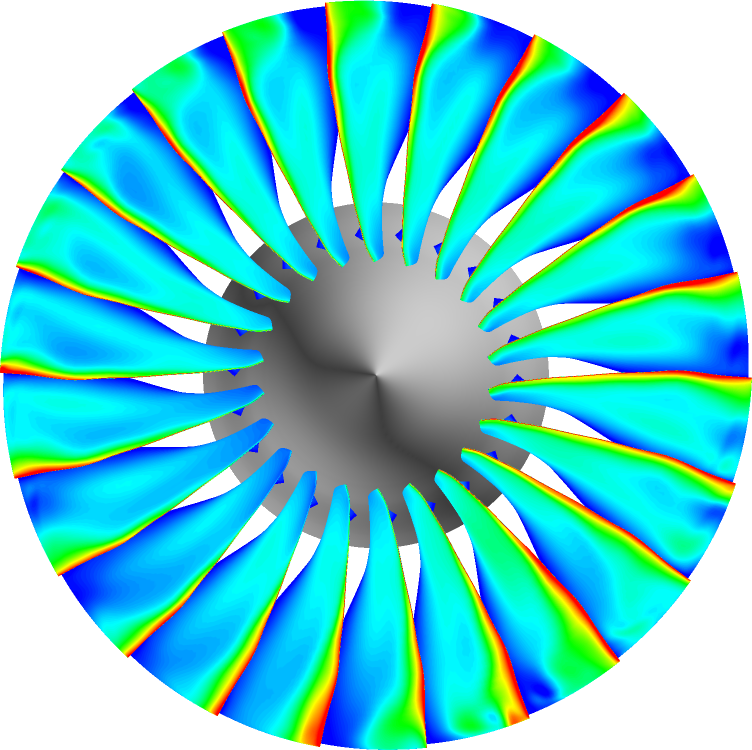
Aviation sustainability is a significant consideration in the designs of future generation aircraft. One way to achieve aviation sustainability is by reducing the overall drag acting on the aircraft. One approach being researched to achieve this goal is the implementation of boundary layer ingesting (BLI) technique. BLI technique has been shown by many researchers around the globe to be able to significantly improve the overall aircraft performance by reducing the drag and noise generated by the aircraft. However, inlets designed to ingest boundary layers tend to develop a large region of low-pressure flow which can drastically harm the overall performance of an engine placed behind the distorted flow. The success of BLI techniques heavily depends on the design of an engine fan that can deliver high aerodynamic performance even under the influence of the distorted inlet flow. The study of this article outlines a procedure to achieve this goal by utilizing computational fluid dynamics-based design optimization methods. The study was broken up into three primary phases which iterated the design of an initial baseline geometry with the primary objective function being the adiabatic efficiency of the fan. The results of this study show that the optimized fans can improve the adiabatic efficiency by around 4–5% when compared to the baseline design.
Tail-Cone Thruster Fan Rotor Flutter Analysis
1 Jan, 2024, Glenn Research Center (Technical Memorandum)
The aeroelastic stability of a tail cone thruster fan was analyzed for three structural modes and various nodal diameter patterns. Computational fluid dynamics modeling with blade vibrations was used in the analyses performed at design (peak-efficiency) and two near-stall conditions at the design rotational speed. Aerodynamic damping was used to assess flutter since this integrally bladed rotor design will have minimal structural damping. Aerodynamic damping was found to be low at the design condition. For the first mode, aerodynamic damping was seen to decrease towards stall, vanishing for a zero nodal diameter pattern. Further decrease in mass flow led to negative aerodynamic damping (flutter) for the first and second nodal diameters in the near stall condition. The flowfield at this lowest mass flow rate exhibited some additional unsteadiness at higher frequency. The sensitivity of results to time step and amplitudes of vibration was examined and found to be very satisfactory. The largest uncertainty in the results comes from the observed sensitivity of the aerodynamic damping to details of the variation of grid deformations in the blade passage mesh from the blade passage to the boundaries. For the parametric variations analyzed, the calculated aerodynamic damping is lower if the grid deformations near the blade surface are higher. Further work is needed to understand the cause of this sensitivity and find possible solutions to reduce the effects on flutter predictions.
A Blade Altering Toolbox for Automating Rotor Design Optimization
31 July, 2023, Communications on Applied Mathematics and Computation (Journal)
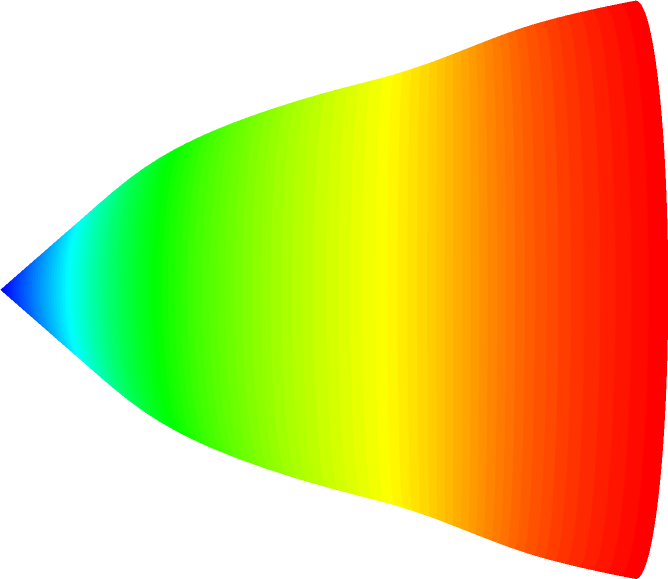
The Blade Altering Toolbox (BAT) described in this paper is a tool designed for fast reconstruction of an altered blade geometry for design optimization purposes. The BAT algorithm is capable of twisting a given rotor’s angle of attack and stretching the chord length along the span of the rotor. Several test cases were run using the BAT’s algorithm. The BAT code’s twisting, stretching, and mesh reconstruction capabilities proved to be able to handle reasonably large geometric alterations to a provided input rotor geometry. The test examples showed that the toolbox’s algorithm could handle any stretching of the blade’s chord as long as the blade remained within the original bounds of the unaltered mesh. The algorithm appears to fail when the net twist angle applied to the geometry exceeds approximately 30 degrees, however this limitation is dependent on the initial geometry and other input parameters. Overall, the algorithm is a very powerful tool for automating a design optimization procedure.
Jet Engine Fan Design Optimization under Distorted Inlet Flow
2023, The Ohio State University (Dissertation)
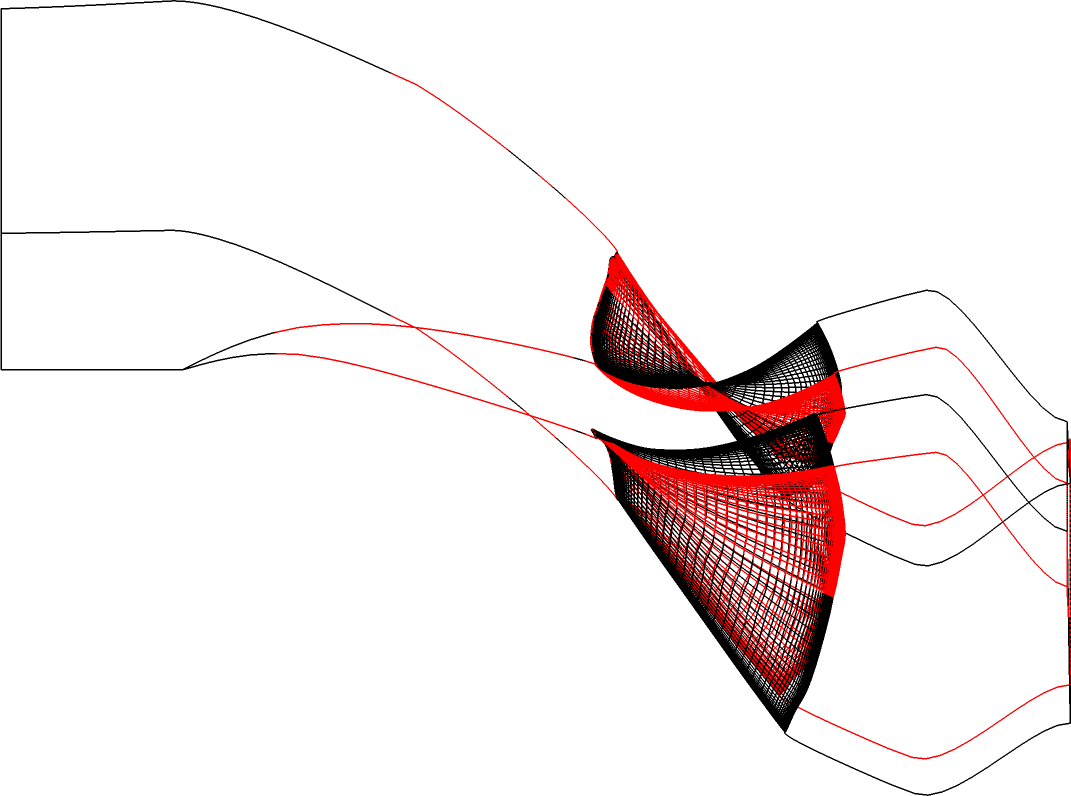
NASA Glenn Research Center has laid out goals to meet the needs of modern day commercial air travel. The goals laid out by NASA aim to reduce the fuel consumption while improving upon the performance parameters of future aircraft. One approach that has been researched to meet these standards is the implementation of a boundary layer ingesting (BLI) inlet. It has been shown that BLI inlet designs can achieve much of the targets set out by NASA. However, BLI inlets can harm the performance of the engine due to the large boundary layer growth which develops at the bottom surface of the inlet. Later studies have shown that the placement of a fan at the aerodynamic interface plane can attenuate the losses associated with the boundary layer growth. However, the severe changes in total pressure and high incidence angles have shown to hinder the performance of the fan and provided risk for the fan to fail due to stall conditions. The goal of this study is to optimize the design of the fan to survive the harsh conditions of the BLI inlet. The optimization was broken up into three primary phases. Phase 1 utilized a 2D optimization approach which sought to independently optimize cross-sections of a single passage under tangentially averaged inlet flow profile, and then restacked the optimized cross-sections to form a new rotor geometry. Phase 2 built upon the optimized designs of the first phase and optimized a single passage of the rotor modeled with a tangentially averaged inlet flow profile using a high end computational fluid dynamics tool called TURBO. A toolbox, labeled the Blade Altering Toolbox, was created for the second phase in order to manipulate the shape and design of the 3D rotor. Phases 1 and 2 were both used to produce a narrowed down design in order to save computational costs. Models of the Phase 2 optimized geometries were analyzed as both a single passage model using a tangentially averaged inlet profile which contained information of the distortion field, and a full annulus model containing the entire distortion profile prescribed at the aerodynamic interface plane. The performance variables of the single passage model compared to their respective full annulus models were virtually identical which suggests that the rotor can be accurately optimized using a single passage model with a tangentially averaged inlet profile that contains the distortion field. Phase 3 then further optimized the designs from Phase 2 by modeling the full annulus with the full distortion field prescribed at the aerodynamic interface plane. The optimized designs each showed a significant reduction in the blade separation and have mitigated the risks of stall occurring within the distortion field. As a result, the optimized designs have also demonstrated a significant improvement in the adiabatic efficiency with a small reduction of the total pressure ratio.
Design Optimization of a Fan Blade under Boundary Layer Ingestion Flow
19 Jan, 2023, AIAA SciTech 2023 Forum (Conference)
Boundary layer ingestion (BLI) techniques have been shown to have the potential to greatly improve propulsive efficiency. The problem with BLI engines is that the distorted flow caused by the growth of the boundary layer can significantly reduce the performance of the engine. This study seeks to build on the results from previous studies by optimizing a baseline rotor design. The optimization process utilized a combination of the Tabu Search method with either the Conjugate Gradient Method (CGM) or the Nelder-Mead Simplex (NMS) algorithm. A custom tool called the Blade Altering Toolbox was developed to automate the design alteration process of the rotor geometry and was used in conjunction with the optimization schemes. Two objective functions were considered in the optimization study. The first objective function, Case T1, was an average of adiabatic efficiency and total pressure ratio while the second objective function, Case T2, was the product of the two. Both objective functions were run using the Tabu Search algorithm. Case T1 yielded a 4.86% increase in the adiabatic efficiency with a 3.29% drop in the total pressure ratio over the baseline. Case T2 yielded a 4.75% increase in the adiabatic efficiency with only a 2.92% drop in the total pressure ratio. Case T2 was then extended using the CGM and the NMS algorithms. The results from both the Case T2 CGM and the NMS algorithms were virtually identical, yielding a 4.71% and a 4.75% increase in the adiabatic efficiency respectively, and a 2.92% and a 2.93% drop in the total pressure ratio respectively.
Rotor Blade Design Optimization for Boundary Layer Ingesting Inlet Fan
5 Jan, 2020, AIAA SciTech 2020 Forum (Conference)
NASA has outlined their goals to improve the quality of air travel for the upcoming aircraft generations. One approach to achieving their goals is to place a boundary layer ingestion engine near the rear of the aircraft. A major drawback to this design is the losses which occur due to the boundary layer growth caused by the serpentine geometry on the engine’s inlet. This study seeks to validate an approach to optimize the design of the fan to be placed in the engine. The Response Surface Method was used to optimize the adiabatic efficiency of the fan by utilizing the incidence angle as the design variable. Two variations of an objective function were used to predict two optimized designs. The first design, Objective 1 (O1), was predicted by only taking the adiabatic efficiency into account for the design objective. The objective function for the second design, Objective 2 (O2), utilized a combination of the adiabatic efficiency and the total pressure ratio across the fan. The designs for O1, O2, and the base design were each modeled as a single blade passage using CFD under flow equivalent to the design condition. The results for O1 demonstrated a significant increase in adiabatic efficiency of about 4.57% when compared to the baseline. However, O1 illustrated a loss in the total pressure ratio of about 4.57%. O2 was designed with the intention of improving the total pressure ratio across the fan at the cost of performance in efficiency. When modeled, the results of O2 also demonstrated about a 4.57% boost in efficiency over the baseline with only about a 3.76% loss in the total pressure ratio. Both objectives resulted in a significant improvement in the overall performance of the fan with the O2 design performing the best at the design condition.
Presentations
“Fan Optimization Under Distorted Boundary Layer Ingesting Flow,” Technical Paper, Turbomachinery Technical Conference & Exposition, Memphis, TN, June 16-20, 2025.
“Aeromechanic Analysis and Optimization of Boundary Layer Ingestion Turbomachinery,” Presenter at the SVC Meeting, Columbus, OH, March 23-24, 2023.
“Design Optimization of a Fan Blade under Boundary Layer Ingestion Flow,” AIAA paper, AIAA SciTech Forum, National Harbor, MD, January 23-27, 2023.
“Aeromechanic Analysis and Optimization of Boundary Layer Ingestion Turbomachinery,” Presenter at the SVC Meeting, Columbus, OH, September 29-30, 2022.
“Aeromechanic Analysis and Optimization of Boundary Layer Ingestion Turbomachinery,” Poster session presented at the SVC Meeting, Columbus, OH, March 24-25, 2022.
“Aeromechanic Analysis and Optimization of Boundary Layer Ingestion Turbomachinery,” Poster session presented at the SVC Meeting, Columbus, OH, September 9-10, 2021.
“Rotor Blade Design Optimization for Boundary Layer Ingesting Inlet Fan,” AIAA paper, AIAA SciTech Forum, Orlando, FL, January 6-10, 2020.
“Aeromechanic Analysis and Optimization of Boundary Layer Ingestion Turbomachinery,” Poster session presented at the SVC Meeting, Columbus, OH, September 19-20, 2019.
“Aeromechanic Analysis and Optimization of Boundary Layer Ingestion Turbomachinery,” Poster session presented at the SVC Meeting, Columbus, OH, March 28-29, 2019.